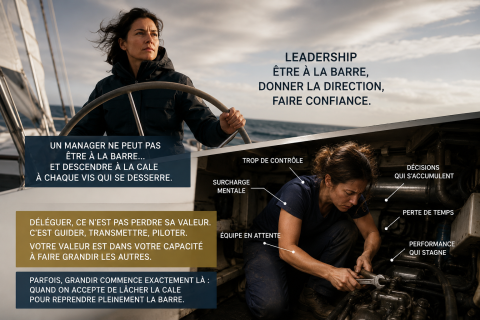
The manager who tries to control everything often ends up slowing their team down.
At sea, the captain never leaves the helm to go and fix every little detail on board.
So why do so many managers continue to do exactly that in their organizations?
At first, it is a strength.
You know your job inside out. You find solutions. You care about things being done well. So you check, correct and step in… because it is faster, or because you believe no one else will do it as well.
Then, gradually, that strength becomes a trap.
The days get longer. Decisions pile up. The team waits for approval before moving forward. Without realizing it, the manager becomes the mandatory checkpoint for everything that happens.
And here lies the paradox:
The more we try to maintain control, the more we limit autonomy, engagement and collective performance.
The transition from being an excellent expert to becoming a true leader is not about technical skills.
It is about mindset and leadership posture.
Learning to delegate with confidence.
Setting clear boundaries without micromanaging.
Developing talent.
Helping others grow.
Accepting that your own success now depends on the success of your team.
On paper, it sounds obvious.
In reality, it is often one of the most difficult transitions of a career.
Because we all have blind spots. Habits and behaviours that helped us succeed up to this point can sometimes become the very things holding us back from our next level.
An outside perspective can often help identify these patterns much faster, open up new possibilities and accelerate a transformation that, on our own, might take years.
The role of a leader is not to make themselves indispensable.
It is to create the conditions for their team to succeed, grow and keep moving forward… even when they are not there.
I have the privilege of supporting managers and executives through these transitions — at the point where technical expertise is no longer enough and where leadership posture becomes a true driver of performance.